7 Bible Stories of People Who Lost Everything and Came Back Stronger
Life is made up of seasons, and many of them include losses that can feel permanent. Losing health, reputation, family, freedom, or long-held dreams may leave us believing that our story has come to an end.
However, the Bible repeatedly shows that loss is never the final word when God is involved.
Throughout Scripture, we meet men and women who walked through deep valleys, lost what mattered most to them, and watched the ground disappear beneath their feet. What defined their stories was not only the pain of their fall, but the power of the God who lifted them again.
When God restores a life, He does more than return what was taken. He rebuilds the person from within, producing greater maturity, strength, faith, and preparation for a larger purpose.
If you are currently facing loss or feel as though you have reached the bottom, these seven Bible stories are powerful reminders that your present pain may become the setting for a remarkable new beginning.
1. Job: Losing Everything and Receiving Restoration
Job was an upright man who feared God and lived a prosperous life. Within a short period, however, he lost his children, possessions, servants, and eventually his health. Painful sores covered his body from head to foot.
His friends questioned his integrity, and his wife struggled to support his faith. Job grieved deeply and openly expressed his anguish, yet he refused to completely abandon God.
“The Lord gave and the Lord has taken away; may the name of the Lord be praised.” (Job 1:21)
At the end of his trial, after Job prayed for his friends, the Lord restored his fortunes and gave him twice as much as he had before. Yet Job’s greatest restoration was not material. He came to know God more deeply than ever before.
“My ears had heard of you but now my eyes have seen you.” (Job 42:5)
Job’s story teaches that faith does not eliminate grief, but it gives us a foundation that suffering cannot destroy.
2. Peter: From Public Failure to Leadership at Pentecost
Peter’s greatest loss was emotional and spiritual. On the night Jesus was arrested, Peter denied knowing Him three times.
Only hours earlier, he had boldly promised that he would remain loyal even if everyone else abandoned Christ. But fear of persecution overcame his courage.
When the rooster crowed and Peter realized what he had done, he went outside and wept bitterly. His tears reflected the pain of a man crushed by guilt and disappointed in himself.
After the resurrection, however, Jesus intentionally restored Peter beside the Sea of Galilee. Three times, Jesus asked Peter if he loved Him, and three times He reaffirmed Peter’s calling to care for His people.
The disciple who had once denied Jesus became the courageous preacher at Pentecost. Through his message, thousands believed, and Peter became one of the leading figures of the early Church.
His story shows that failure does not have to erase our calling. In the hands of Christ, even our deepest shame can become part of a testimony of restoration.
3. Joseph: From the Pit and Prison to Leadership in Egypt
Joseph lost his home, his father’s companionship, and his freedom when his jealous brothers sold him into slavery.
In Egypt, his life briefly appeared to improve while he served in Potiphar’s household. But after being falsely accused by Potiphar’s wife, Joseph was sent to prison for a crime he did not commit.
Despite betrayal, slavery, injustice, and years of confinement, Joseph refused to let bitterness control his heart. He continued serving faithfully wherever he was placed.
At the appointed time, God brought Joseph out of prison and placed him in a position of authority over Egypt. The former slave became the governor responsible for preparing the nation for a severe famine.
God eventually used Joseph not only to save Egypt, but also to preserve the lives of the same family members who had betrayed him.
“You intended to harm me, but God intended it for good to accomplish what is now being done, the saving of many lives.” (Genesis 50:20)
Joseph’s story reminds us that delays and injustices cannot cancel God’s purposes.
4. Ruth: From Widowhood to the Lineage of the Messiah
Ruth was a Moabite woman who suffered the devastating loss of her husband while still young. She had no children and little social protection in the ancient world.
Her mother-in-law, Naomi, had also lost her husband and both sons. Naomi encouraged Ruth to return to her own family, but Ruth chose loyalty over personal security.
“Where you go I will go, and where you stay I will stay. Your people will be my people and your God my God.” (Ruth 1:16)
Ruth left her homeland and traveled to Bethlehem, where she began again with almost nothing. She worked in the fields, gathering leftover grain to provide food for herself and Naomi.
Her faithfulness and integrity caught the attention of Boaz, a respected relative who became the family’s kinsman-redeemer. Ruth eventually married Boaz, received a new family, and became the great-grandmother of King David.
As a result, this foreign widow was included in the human genealogy of Jesus Christ.
Ruth’s life teaches that loss does not exclude anyone from God’s redemptive plan.
5. Samson: From Lost Strength to a Final Victory
Samson received supernatural strength and a special calling to deliver Israel from the Philistines. However, he repeatedly surrendered to temptation and failed to honor the responsibilities connected to his Nazirite vow.
After revealing the secret of his strength to Delilah, Samson was captured. The Philistines blinded him, imprisoned him, and forced him to grind grain as a slave.
The man once celebrated for extraordinary strength became a powerless object of public humiliation.
Yet while Samson remained in prison, his hair began to grow again. This physical detail pointed toward a deeper process of humility and renewed dependence on God.
During a Philistine celebration, Samson was brought into a pagan temple to be mocked. There, he prayed one final time:
“Sovereign Lord, remember me. Please, God, strengthen me just once more.” (Judges 16:28)
God answered his prayer, and Samson achieved his greatest victory in the final moment of his life.
His story is both a warning about destructive choices and a reminder that sincere dependence on God can still matter, even after severe failure.
6. David: From the Ruins of Ziklag to the Throne of Israel
Before becoming king over Israel, David spent years living as a fugitive. One of the darkest moments of his journey occurred when he and his men returned to the city of Ziklag.
They discovered that the Amalekites had burned the city and taken all the women and children captive. David and his warriors wept until they had no strength left.
The grief became so intense that David’s own men discussed stoning him. They blamed him for the devastating loss.
In that moment of total crisis, Scripture says:
“But David found strength in the Lord his God.” (1 Samuel 30:6)
David sought God’s direction and then led his men in pursuit of the Amalekites. They recovered everyone and everything that had been taken.
Nothing was missing.
Shortly afterward, David entered a new stage of his calling and was eventually established as king.
His experience teaches us to seek strength in God when circumstances and even people turn against us.
7. Naaman: From Disease and Pride to Healing and Faith
Naaman was a successful commander in the Syrian army. He was respected, courageous, and powerful. Yet beneath his military achievements, he lived with a devastating condition: leprosy.
The disease threatened his health, dignity, and future.
After hearing the advice of a young Israelite servant, Naaman traveled to seek the prophet Elisha. He expected an impressive public miracle, but Elisha simply instructed him to wash seven times in the Jordan River.
Naaman initially became angry. The command seemed too simple and humiliating for a man of his position.
However, his servants persuaded him to obey. Naaman entered the river, washed seven times, and was completely healed.
“His flesh was restored and became clean like that of a young boy.” (2 Kings 5:14)
Naaman’s restoration required more than physical healing. He also had to surrender his pride. Afterward, he acknowledged that the God of Israel was the true God.
His story teaches that some restorations begin when we become humble enough to obey God’s instructions.
What These Stories Teach Us About Loss
These biblical stories reveal several powerful truths:
- Loss does not mean God has abandoned us. He often works most deeply in seasons when everything feels uncertain.
- Restoration may begin internally. Before changing circumstances, God frequently transforms character, faith, and priorities.
- Failure and suffering do not cancel divine purpose. Peter, Samson, and David all experienced severe setbacks, yet God continued working in their lives.
- Humility prepares the way for renewal. Job, Naaman, and others encountered restoration after surrendering pride and control.
- God can use pain for a greater purpose. Joseph’s suffering eventually became part of the deliverance of an entire nation.
Conclusion
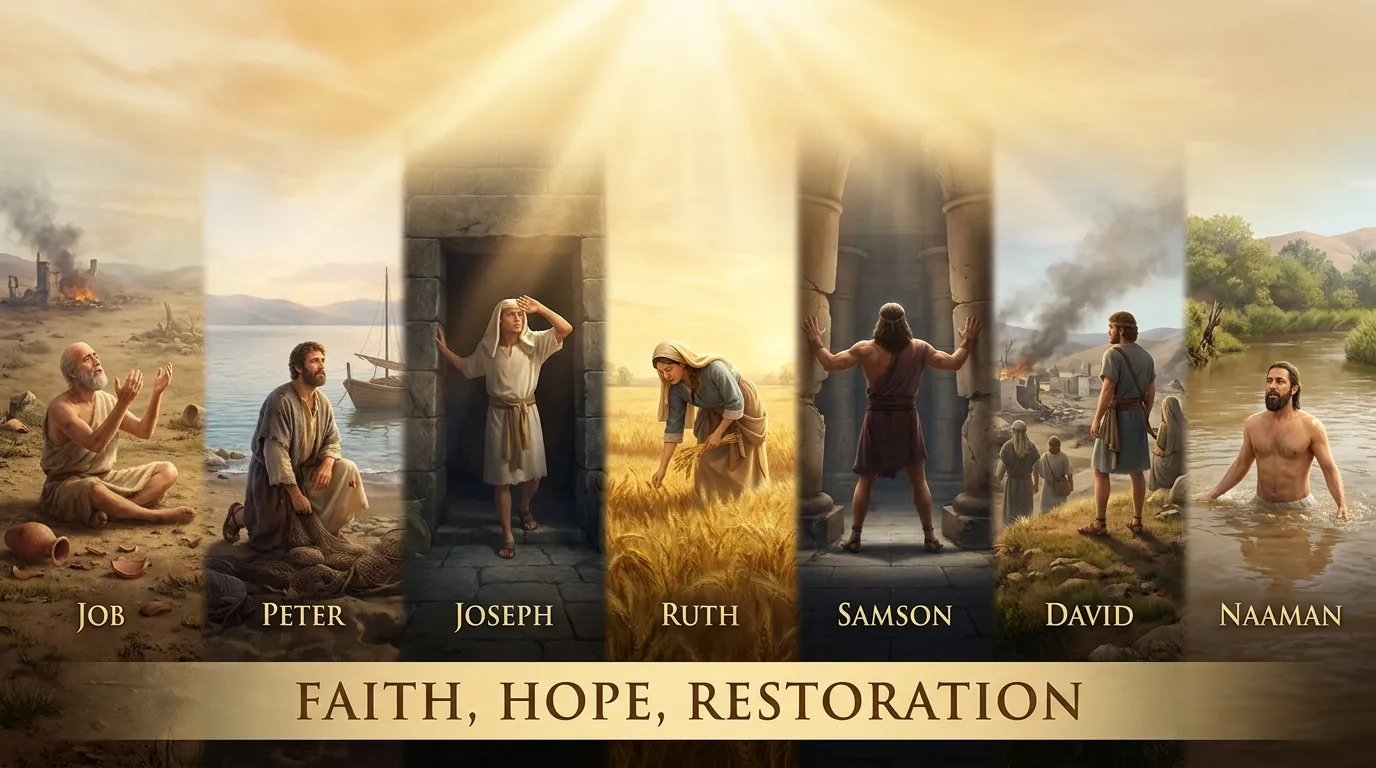
The stories of Job, Peter, Joseph, Ruth, Samson, David, and Naaman teach us that loss is never the final chapter when a life is placed in God’s hands.
Pain may expose our weaknesses, rearrange our priorities, and lead us into seasons we never expected. But it can also become the ground where God plants the seeds of restoration, maturity, and renewed purpose.
No matter how great your present loss may feel, the God who brought Joseph out of prison, gave Ruth a new family, restored Job, and strengthened David is still alive and active.
Place the broken pieces of your story in His hands. Trust that He can rebuild what appears ruined and prepare you to rise with deeper faith and greater strength.
If these Bible stories strengthened your faith, share this article with friends and family who need encouragement and hope for a new beginning.