The Story of Moses: From Egypt to the Promised Land
The Story of Moses: From Egypt to the Promised Land
Who was Moses and what was the context in Egypt?
The story of Moses is one of the most inspiring narratives in the Bible. It reveals a profound process of transformation, liberation, and the fulfillment of God’s purpose. Born during a time of oppression, Moses was chosen by God to lead the people of Israel out of slavery in Egypt and into becoming a nation that reflected the Lord’s character.
The book of Exodus recounts the growth of Israel in Egypt. They had settled there in the days of Joseph (Genesis 46), but over time, a new pharaoh “who did not know Joseph” (Exodus 1:8) rose to power. Fearing that the Hebrews, descendants of Jacob, would become a political and military threat, he enslaved them, imposing forced labor and ordering the death of newborn Hebrew boys (Exodus 1:22).
It was in this context that Moses was born. His parents hid him for three months and, trusting God, placed him in a basket (“tebáh,” the same word used for Noah’s ark) and set him on the Nile River. Pharaoh’s daughter found the baby, adopted him, and raised him as a prince of Egypt (Exodus 2:5,10). Thus, Moses grew up with a dual identity: Hebrew by birth and Egyptian by education, familiar with both cultures.
The burning bush: the mission and the divine name
After fleeing Egypt, Moses lived for about 40 years in Midian, a desert region inhabited by shepherds and nomads. This period was not wasted: God was shaping him. Before leading a people, he learned to care for flocks; before speaking before kings, he learned to listen in silence.
The turning point came on Mount Horeb (Exodus 3), when he saw an unusual sight: a bush burning with fire but not consumed. The fire symbolized God’s holiness and presence, while the undestroyed bush represented divine grace that purifies without destroying.
As Moses approached, God called him: “Moses! Moses!” The repetition indicated urgency and intimacy. God identified Himself as the God of Abraham, Isaac, and Jacob—reminding Moses He was not a new deity but the same covenant-keeping God of generations past.
When Moses asked God’s name, an essential question for presenting himself to Israel, God replied: “I Am Who I Am” (Exodus 3:14). In Hebrew, Ehyeh Asher Ehyeh, this phrase revealed more than a name—it expressed His eternal, self-sufficient, ever-present nature.
Moses resisted the call, claiming he was not eloquent or credible. Yet God promised to be with him, gave him signs (like the staff turning into a serpent), and appointed Aaron as his helper. This shows that God does not choose the qualified—He qualifies the chosen.
The ten plagues and the Passover
Back in Egypt, Moses became God’s spokesman before Pharaoh. The initial request was simple: “Let my people go, so that they may worship me in the wilderness” (Exodus 5:1). But Pharaoh’s hardened heart revealed a larger battle—spiritual as much as political. Each of the ten plagues (Exodus 7–12) directly confronted Egyptian gods: the Nile turning to blood challenged Hapi, god of the river; the frogs mocked Heket, goddess of fertility; the darkness humbled Ra, the sun god.
The tenth plague, the death of the firstborn, brought the most symbolic moment: the institution of the Passover. Each family was to sacrifice a spotless lamb and put its blood on their doorposts. When the destroying angel passed by, he spared the marked houses. This event not only freed Israel physically but also pointed to Christ, the Lamb of God, whose blood saves us from eternal condemnation (John 1:29; 1 Corinthians 5:7).
The Red Sea and the school of the desert
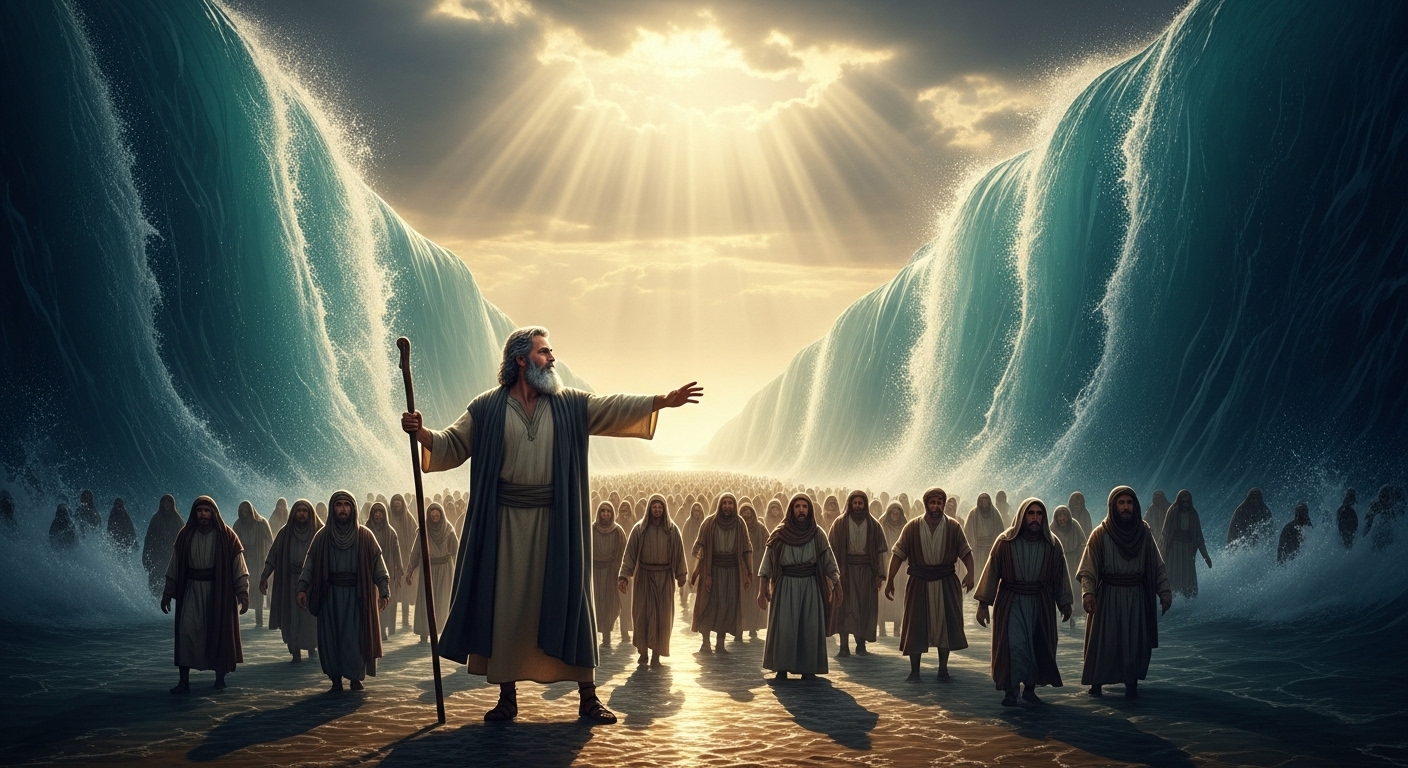
Freed from Egypt, the Israelites soon found themselves trapped between the sea and Pharaoh’s army. Fear made many want to turn back. But Moses declared: “The Lord will fight for you; you need only to be still” (Exodus 14:14). God parted the Red Sea, allowing Israel to cross on dry ground; the Egyptians who followed were drowned.
The crossing was not the end but the beginning. The desert became a spiritual school: God fed them daily with manna, provided water from the rock, and guided them with a pillar of cloud by day and fire by night. This period taught that true freedom is not doing whatever one wants, but depending on the One who sustains.
Sinai: Covenant, Law, and Presence
At Mount Sinai, Israel experienced a collective encounter with God. Thunder, lightning, and a powerful voice marked the giving of the Ten Commandments (Exodus 20). More than moral laws, this was the sealing of a covenant: God would be their Lord, and they would be His people.
The Law included principles of justice, worship, and holiness, as well as instructions for building the tabernacle—the place symbolizing God’s dwelling among them. His presence was Israel’s greatest treasure—not land or resources, but God Himself with them.
Fall, intercession, and restoration
While Moses was on the mountain receiving the tablets of the Law, the people grew impatient and built a golden calf (Exodus 32). This act of idolatry nearly cost them God’s presence. Moses interceded with boldness and pastoral love: “If your Presence does not go with us, do not send us up from here” (Exodus 33:15). His prayer sought not only forgiveness but the continuation of relationship with God.
God renewed the covenant, showing His mercy is greater than sin when there is repentance and intercession.
The legacy of Moses
Toward the end of his life, Moses gathered the people and repeated the Law in Deuteronomy, preparing a new generation for the Promised Land. From Mount Nebo, he looked over the land but did not enter (Deuteronomy 34). His mission was not to finish the journey, but to point forward.
Centuries later, Jesus would be recognized as the “prophet like Moses” (Deuteronomy 18:15; Acts 3:22), but greater than him—not only delivering from physical slavery but from sin, and not only leading to a land but to an eternal covenant.
What does the story of Moses mean for us today?
The story of Moses is more than history; it is a spiritual model. Just as Moses was called from obscurity, God still calls ordinary people for extraordinary missions. Just as the blood of the lamb saved Israel, the blood of Christ redeems us. Just as God’s presence guided Israel in the desert, the Holy Spirit guides us today.
It teaches us the importance of:
- Obeying God’s call promptly.
- Valuing His presence above any achievement.
- Leading with humility, even amid opposition.
- Trusting that every desert is preparation for something greater.
Conclusion
The journey of Moses reveals that true victory is not merely reaching a land but walking with God. He was a liberator, lawgiver, and intercessor, but his greatest work was pointing to Christ, the ultimate Deliverer.
If this article blessed you, share it with your friends and family!